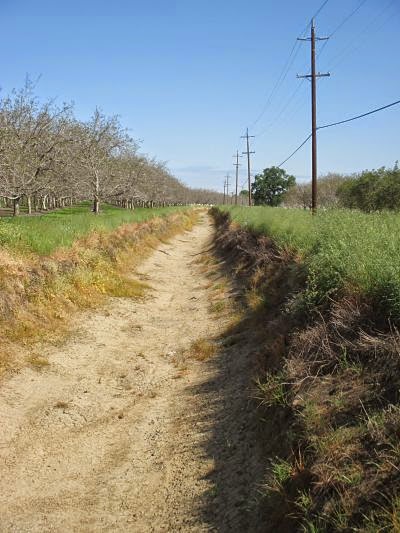
After spending three months last spring in the San Francisco Bay Area and in Silicon Valley I witnessed first-hand what it means to live through years of drought as a gardener.
Well-meant incentives are offered from some municipalities or counties to homeowners in an attempt to reduce or eliminate lawns and exchange it with native plants that do not require much water. Great idea - if executed! And also, if the cities themselves would stop the heavy watering of lawns during night. Every morning water from the park in Saratoga was running down the road.
In the Sacramento area I even discovered a cemetery that has been watered! In several areas where pressure pipes installed that shot out gallons of water per second... as you can see at one of the pictures below. And two miles from this cemetery was a creek - totally dried out.
.

Two Days of Rain in Three Months
Yes, that’s not a typo! January, February and March are usually the wettest time of the year. Not anymore… I saw water reservoirs that where only half-filled. On these two rain-days the water was not even able to penetrate the heavy clay soil deeper than 3 inches. How can roots soak up rainwater in this kind of soil? Nothing easier than this: compost, raised beds and mulch.
Gardeners: Improve Soil Conditions
Gardening and landscaping design starts with great soil, amended with compost. Flowers, shrubs and trees can only flourish when they get (natural) nutritions. Composted soil stores water much longer. I saw million-dollar homes with front yards which looked like 3rd-world places or sub-Saharian Africa. Driving a lot and walking my dog in residential areas I was shocked how few home-owners care about their garden soil.
And it’s not my opinion, I talked with several Nursery owners and they second my observations. Another problem is that many homeowners go the convenient way and order the service of so-called “landscapers”. Not a good idea, as these people are labourers, not professionals and are not trained at all to improve gardens and keep them healthy. I watch them with disgust… In California (and maybe somewhere else too) they have only three garden devices: a leaf blower, a lawn mower and a huge container full of Round-up!
.
Instead of composting, the leaves they collect, go into the garbage. Having a lawn is one of the worst gardening decision anyway, and about the topic of Round-up I have written already here on this blog… Want proof how bad this is for our health? Just read scientific research results what causes cancer, depressions, Parkinson’s etc. You will never allow any pesticides near your garden again!

Make Your Own Compost Soil
Nothing easier than this! Everyone drinks coffee or tea at least once a day, together with fruit peels and vegetable / salad scraps, wrap it into two sheets of newspaper. These tea leaves and the coffee grind makes a good start. You can even ask the nice people at Starbucks to give you some more grinds, as it makes a beautiful soil (and smells nice). Crush eggshells, rip eggcartons and toilet paper roll endings in small pieces, add paper from your office shredder, tissue paper, napkins … the list goes on and on. Important is that you use not more than 20 percent wet stuff, the rest needs to be dry material. In areas where there are not tree or shrub roots in the way, one can dig a hole into the ground, ca 1 ft wide and deep, fill it with the compost, top with a layer of soil, poke a couple of holes with a stick to allow some air - and voila! in 3 weeks it turns into beautiful dark, crumbly soil. If you want to start a compost heap in a corner of the garden: It needs only some chicken wire and a couple of sticks to construct one. Once it is “cooked” use a small hand-fork to fluff your heavy garden soil and incorporate the compost in it.
.
Raise the Flower Beds
Soil is very inexpensive, one of the cheapest ingredients for gardening, and compost doesn’t cost anything at all - plus it helps to reduce landfills and municipal expenses. Why not raise the garden beds? Every plant, from the smallest flower to the largest tree needs space. Reading the labels when purchasing plants explains the minimum space for planting and also shows how large the mature plant will grow. Planting should be usually double the width and dept of the pot. If the new plant is in an 8-inch deep pot, it needs AT LEAST a 16-inch deep planting hole. Building raised beds like a mini-landscape is not only a part of garden design, but also allows new (and old) plants to stretch their roots and grow better as they can easier reach moisture and nutrients. …

Mulch, Mulch and Mulch More
I am talking here about natural cedar mulch or cedar bark, that is not color-stained. Garden owners can order it by the truck load, or for small places buy at HomeDepot or other garden centers. Cover the soil with at least a layer of 4-6 inches deep. Why mulching? First of all, mulch prevents the soil to dry out. You need less water and the irrigation cables are well-covered. Mulch prevents weeds up to 95 percent, and if there are any at all, they are very easy to pick out. Mulch also evens out extreme temperatures, which means in California, mulched garden soil doesn’t get as hot, doesn’t dry out and subsequently doesn’t need as much water. What more can you ask for?
.
These essential tips for savvy and eco-friendly gardening are not only useful in drought areas, such as California and the US-Southwest or the small semi-arid part of British Columbia, but also for any garden, no matter where. Rich compost soil, raised garden beds and natural mulch cover will improve your garden tremendously!
Useful Links for Bay Area Gardeners
Best soil available in the Bay area
http://www.wheelerfarms.net/products.htm
Plant wholesale with list of nurseries
http://www.suncrestnurseries.com/californianatives.php
Every spring (late March) a must-event for gardeners
http://sfgardenshow.com/
One of the best Garden Designers in the Bay Area
http://harmonyinthegarden.com/speaker/
<><><><><>