ARRIVING IN BUENOS AIRES
Visa:
The maximum number of days for a tourist visa granted by Consular Offices is ninety (90) days. This term can be extended once, for the same number of days, at any of the Delegations of the National Migration Directorate before the original visa expires. To know if you need a visa go to: http://www.mrecic.gov.ar/portal/temas_consulares/visas/visas.html
Consulates and Embassies in Argentina:
Foreigners visiting Buenos Aires can contact their consulates and embassies for any kind of documentation processing and general advice.
Avoid peak winter (August) and summer (January) if you want the best weather, and aim instead for spring, which lasts from September through November, and fall, which lasts from March through June, for lots of sunshine and not too warm days.

EZEIZA International Airport
https://buenosairesmap360.com/buenos-aires-airport-map
If you don’t want to pay at least $40 for a taxi, or $18 for a shuttle, then opt for the least expensive way: for less than $1 the public bus #8 drives directly to Plaza Mayo, Congress area, and Av. de Mayo. The bus leaves the airport about every 30 minutes. However, you need to get a SUBE card as you cannot purchase a ticket or pay the driver. You can get it directly at one of the 24-hour kiosks. It can also be found at the so-called Puntos SUBE, which are kiosks, train and subway stations, lottery agencies, and post offices.
JORGE NEWBERY National Airport
Three lines make the trip to downtown: # 37 goes through Palermo, Recoleta, Retiro, and Center; #160 crosses the entire city through Palermo and Almagro; and #45 goes to Retiro, Centro, and San Telmo. You will also need a SUBE card to take buses in the city. I bought my SUBE card on the 2nd floor in a 24-hour kiosk.
The busses stop/depart directly in front of the airport arrival building
BTW: It sometimes happens that international flights are also landing at the Newbery airport, which is much closer to the city.

.
FLYING WITHIN ARGENTINA
Distances between cities and natural tourist hotspots - Glaciers around El Calafate, the green city Mendoza, or the mighty Iguazu Falls - are immense in this fast country! Better choose one of the cheap flights within Argentina to reach places such as Bariloche, Ushuaia, Iguana Airport, Cordoba, Salta, Mar del Plata, or El Calafate, just to name a few. 1,000-kilometer flights are often available for less than US$90.
Almost all of these flights depart from Buenos Aires Newbery Airport and are served by Aerolineas Argentina. As earlier you book, as cheaper these flights will be. Flying down south, try to get a seat on the right side in flight direction to (hopefully) see the Andes with its dozens of volcanos. Flying from the country´s south to the north, get a seat on the left-hand side.
One of the best flight routes to use is from Buenos Aires to Ushuaia, which will cost around $200. It seems steep, but the bus is almost identical in cost (however it will only take a few hours compared to the giant 50-hour (2,5 days!) bus journey down south!

TRANSPORTATION IN BUENOS AIRES
Despite the dimensions of the city, I have never had a problem getting from point A to B, there are thousands of taxis, hundreds of busses, and many subway stations. Taxis can be hailed on almost every street, sometimes you can even choose which one you take. Highly visible red lights sign ¨LIBRE¨ on the windshield and indicate that the taxi is free.
IMPORTANT: before the driver starts, check that he has started his taximeter! It happens rarely, but make sure to see the device set to the minimum fare (ca. 600 pesos - 60 cents) in 2023/ early 2024. Exceptions are the taxis that depart from the airports and the ferry station. They have set prices (that are mostly way too high!).
Tips are very much appreciated, a thousand pesos bill (ca. US$1) is perfect.
Give the driver a precise address that he can type into his navigation device, and don’t forget to say ¨per favor¨. I have experienced several times that the drivers don’t know the city well, and often have no clue where all the museums are.

To find out which bus to take within Buenos Aires, type your departure address (e.g. the address of your hotel) and the house number and street of your destination on a Google map, and you will receive the bus number (s) or subway direction, as well as departure and arrival times.
Subway wagons are clean and safe (at least during the day hours)
Here is the Subway map of Buenos Aires:
https://buenosairesmap360.com/buenos-aires-metro-map
If you rent a car - which is really not necessary and a hassle to get parking - be aware that many roads in Buenos Aires are one-way!

Forget Paris! Comparing these two cities, Buenos Aires is the one to travel to!
Diving deep into the history and social facts of Argentina, learning about the amazing flora and fauna, and trying the delicious food and wine that is offered in countless restaurants, coffee houses, bars, and bakeries shows the rich history and culture of Buenos Aires.
Buenos Aires´ prime time was between 1860 and 1920 and the countless history, art nouveau, and art deco buildings in the city are amazing - including the wonderfully created entrance doors, and even the old-fashioned elevators!
Read more here:
https://a-happy-traveler.blogspot.com/2024/02/buenos-aires-architecture-paris-of.html

BUENOS AIRES CITY TOURS
To explore the city, you have several options:
- Take a hop-on, hop-off bus tour
- Take free walking tours
- Or just take one of the many inexpensive buses (with your SUBE card) and drive to museums, sightseeing places, theaters, and Tango places. Or explore the city on foot.
It all depends on how many days you are spending in Buenos Aires…
If you just stay between 3-5 days in the city, take the bus tour. Maybe twice. Tickets are valid for 24 hours. They can be purchased at several stores and kiosks in tourist areas, one is at Av Mayo and Piedras, next to Cafe Tortini.
Start at 2 pm on the first day and stop at the places or museums that interest you most. They are mostly open until 7 or 8 pm. Then the next day start with the first bus, stop at monuments and interesting places, such as the Congress or La Boca, and at 10 or 11 when the museums open, hop-off the bus.
Read more here about the most famous museums in Buenos Aires. These are only the ones where the buses stop. But Buenos Aires has several dozen museums that are worth visiting, especially if you speak a bit of Spanish. Check out their websites or articles on the Internet, copy and paste the text, and place it on translation sites, such as deepl.com. All this can be done long before you travel to the city to get the most out of your visit and to be prepared for the treasures the city offers.
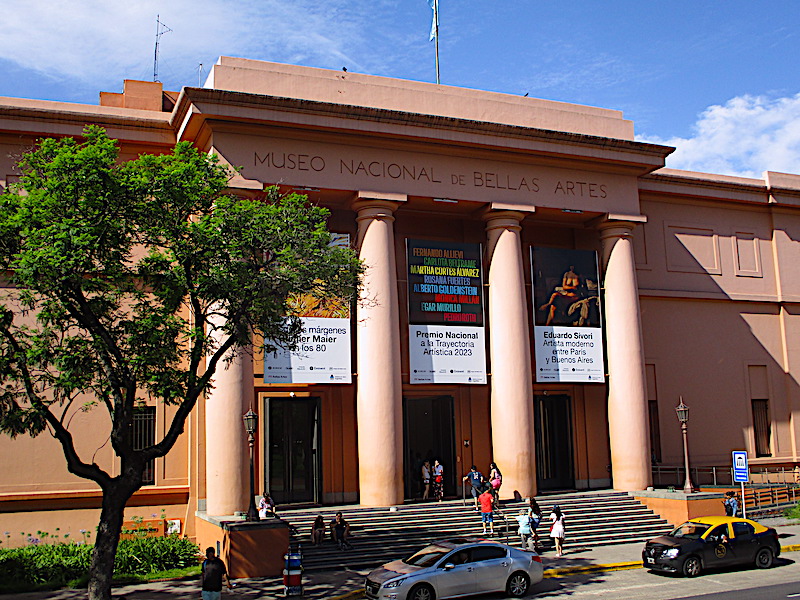
If you stay a week, a month, or even longer in the city take the free walking tours, drive by bus (collectivos), subway, and take advantage of the many free or inexpensive museums and cultural events. Plays, concerts, and movies are dirt cheap compared to other Western and European countries.
Really free are the free walking tours not - guides are expecting two or three dollars (or 3,000 pesos).
They are not paid and this is the only way to make a living. Here are two samples of these tours.
Free Tour City Center
Schedule: Everyday.
Start: 3 pm in English.
Duration: 2:30 hours
Meeting Point: Front Gate of the National Congress. Av. Entre Rios 51
Look for the Guides in Orange!
La Boca Tour
Schedule: Monday to Saturday.
Start: 11 am in English.
Duration: 2 hours
Meeting Point: Corner of Magallanes and Caminito (next to CACHAFAZ shop).
Look for the Guides in Orange!

MONEY, MONEY, MONEY …
Exchanging dollars or euros into Argentinian pesos outside of the country is almost impossible.
In 2023 and 2024 a rough exchange number is 1,000 Argentinian pesos is roughly 1 USD. Pesos in Argentina and Chile have also the $ symbol, don’t confuse it with US dollars.
The only bill in Argentina is 1,000 pesos. When you exchange 100 USD, you will get 100,000 pesos -
a bag full of money. I don´t think they have bank robbery, it would be too heavy to carry the money away : )
It makes for long waiting times in stores, when people pay cash. When using credit cards in stores, you always have to show your ID - also not in restaurants. I never should my passport so often than in Argentina.
Foreigners who pay with a foreign credit card, debit card, or via bank transfer must present foreign ID or supporting documents from the national migration authority in order to be exempt from the 21% VAT. However, not all businesses are familiar with this...
Avoid exchanging your money after landing at the airport exchange counters, you will pay way more than Exchanging at an ATM or in downtown Buenos Aires. In the meantime pay everything with your credit card, and offer your taxi driver US dollars - but check the exchange rate before - and bring US dollars not only in 100 bills, but also a handful of one and five-dollar bills for small payments.
It is advisable to buy pesos in authorized currency exchange offices or banks if you are traveling in less populated areas, e.g. in Patagonia. Taxi drivers are taking mostly cash only, and to hand a tip to a waitress also requires cash.
Besides some Western Union branches, several exchange kiosks in the city center offer reasonable prices, for example, one at the corner of Av de Mayo and Piedras. Or you can walk through Calle Florida where dozens of street vendors offer the ¨dollar blue¨ exchange rate. Very rarely is counterfeit money reported. There is a huge difference between the official course that the banks offer, and the in-official dollar blue course.
Major towns in Chilean and Argentinian Patagonia have ATMs. But please note that El Calafate and El Chalten are notoriously problematic with obtaining cash, so try to plan ahead and withdraw enough cash in Buenos Aires. Make sure to arrive in remote areas with plenty of cash, as credit cards will not be accepted everywhere. I was lucky in El Calafate as my hotel was exchanging ¨dollar blue¨at the unofficial favorable rate and I received bundles of money.
Avoid purchasing tours on the Internet!
They are often double the price you pay compared to local travel agencies. I ordered an excursion to the Chilean National Park and paid USD 195. Walking the next day through El Calafate, I stopped at a local travel agency that offered the same tour, with the same company for only US$ 92.
Talking about money, here are some examples of inexpensive purchases (all in USD):
- Hairdresser between $8-$12
- Manicure, pedicure between $8-$12
- 1 Hour Professional Massage $9-$14
- Lavanderia/Laundry Service $2 - $4
- 1 Cafe and 2 Croissants $2 - $3
- Empanadas from a bakery $2 - $3
- Lunch (outside of tourist places) $3 - $6
- Bus and metro fare $0.50 - $0.80
- Taxi fares for a twenty-minute drive ca. $3

Mate Tea Selection
TRAVEL INSURANCE
If you want more comprehensive coverage that includes not only medical expenses but also trip cancellation, baggage loss, and other potential issues, a comprehensive travel insurance policy is recommended. The cost for this type of coverage can range from $100 to $500 or more, depending on the length of your trip and the specific coverage options you choose.
It's important to compare travel insurance policies from different providers to find the coverage that best meets your needs and budget. Be sure to read the policy details carefully and understand what is and isn't covered, as well as any deductibles or exclusions. Additionally, some credit cards and travel booking sites offer travel insurance as a benefit or add-on, so be sure to check those options as well.
SAFETY
Buenos Aires is a safe city, but like in any big city in the world tourists should take some precautions. For example, do not leave bags or purses hanging from chairs in public places, and do not walk at night in poorly lit streets. Make a photocopy of your personal IDs and leave the originals at your hotel/home.
ELECTRICITY & IT
Travel with an adapter for your hair dryer, electric shaver, or electronic devices either before or right after you arrive. The electric plug-ins in Argentina are very different from what we use in Europe or North America. If you purchased a worldwide working electrical device, fine. However, they are often heavy and bulky. I tried to find a lighter one as I did not want to use a suitcase or carry-on when traveling to Argentina but was out of luck in Canada, the U.S., and Mexico. Not even at the airport in Buenos Aires I found one. Strolling through El Calafate on my first day, I saw an electronic store, and sure enough, they carried exactly what I had in mind - for only 1,000 pesos, which is just US$1.20 or 1.50 Canadian.
Purchasing a SIM card provides you with a local phone number and data plan. The cost of a SIM card depends on the data plan and provider, but it usually falls between $10 and $30. Additionally, free Wi-Fi is available in certain locations, such as cafes, restaurants, hotels, and some public areas.
TRAVELING OVERLAND
Many people, however, don’t fully appreciate how huge the country is — 60% the size of Europe — or that it also offers tropical jungle in the north and Antarctica-like glaciers in Patagonia.
For transportation, only Taxis and other local transportation in towns and cities are still very affordable.
Traveling in Argentina by bus, however, is NOT CHEAP despite everything I read and heard. Maybe ten or twenty years ago it was.
What I read and was told, that it is a comfortable way to travel by overland bus in Argentina is NOT TRUE either. I tried several bus companies, and the seats were ok, but dirty, some even soiled. The promised snacks or drinks were never provided. TV and other entertainment did not work.
The drivers did NOT speak any word of English, and most of all they did not announce the names of the stations, so you never knew when to disembark in the middle of the night. The air-conditioning worked so effectively that it was freezing cold, and then suddenly an hour later it got hot on the bus so my jacket was almost burning. I tried to book over the Internet, but in the listing of countries, Canada was missing. I had to take a taxi and drive to the bus terminal to book it there. What a nuisance.

Bus rides are not advisable to say it nicely… Busses run often at night, so you might have to be at the terminal at 2 am. They are run down, not clean due to missing garbage cans, and packed with travelers. Imagine when sixty people take off their shoes … I constantly wore my face mask - and not only for health reasons.
The only washroom was disgusting. Don’t drink anything to avoid using it. It was all topped when the night bus broke down. I called a taxi from the hotel and when I arrived at 01:20 at the bus station, no bus was there. Me and other passengers waited and waited and finally, an hour later we learned that the bus wouldn’t come until at least 07:30 am. I considered driving back to my hotel for a couple of hours of sleep. But the employee at the counter who did not speak any English, translated for me on his iPhone that it was just too risky. And he was right: Short after 05:00 he got the order to drive us six passengers in his pickup truck to the - in the meantime repaired - bus which was in the middle of nowhere waiting for us. Instead of arriving in Esquel at 11:00 am, it was 15:00 pm when this drag was over.
One of the buses, however, had entertainment: Non-stop commercials and then hours of old science fiction series .. But still no drinks or snacks I then had enough of this bus trouble and searched the Internet for flights from Bariloche to Mendoza, and then to Cordoba, and from there to Buenos Aires. Surprise, all these flights were only between 50 and 90 US dollars! Compared to the distance and the price, flying is much cheaper in Argentina than taking the bus.
TAKE YOUR TIME
Choose a manageable itinerary that works within your time frame. Traveling to Argentina takes a long time — 10 hours from Miami, 14 from Europe — and so does traveling around the country. The best destinations within Argentina require an internal flight from Buenos Aires, normally about 1 1/2 to 2 hours per segment but sometimes longer (Ushuaia-4 hours). Because most regions are worth visiting for at least 3 - 5 nights
Remember that the seasons are reversed in the southern hemisphere. Unless you are looking to go skiing, most travelers will want to visit Argentina in the Spring and Summer, between late October and early April, when temperatures are more moderate and rain less plentiful. However, if your focus is mainly on the north — e.g. Buenos Aires and/or Iguazu Falls — then you can visit year-round.

- Buenos Aires, the “Paris of the South”, is worth at least a week.
- Glaciers National Park (Calafate) is the best place for seeing — and trekking on — glaciers within Argentina. The incomparably beautiful Perito Moreno glacier may just be the loveliest glacier outside Antarctica. Recommended at least 5 nights - if the weather fits.
- Mt. Fitzroy (El Chalten) is one of the two most impressive sites within Argentina’s southern Patagonia region (the other being the Perito Moreno glacier). A 3 1/2 hour drive from Calafate, this is a truly outstanding spot for scenery and hiking. Great for photographers. We recommend spending 3 nights at Fitzroy.
- The Lake District (Bariloche, Villa La Angostura) is justifiably called “Little Switzerland” for its mountains, lakes, rivers, lush vegetation, and many adventure options – hiking, whitewater rafting, horseback riding, and kayaking. At least 3 - 5 nights.
- Iguazu Falls is widely considered one of the two most impressive falls in the world — MUCH more impressive than Niagara or Angel Falls. Only Victoria Falls in Africa is on par with Iguazu Falls. Depending on flight logistics, we recommend spending one or two nights to see both the Argentine and Brazilian sides, which offer completely different views.
- The Valdez Peninsula region is the best spot for wildlife viewing in Argentina. You can visit a huge penguin rookery in Punta Tombo, and observe whales, sea lions, elephant seals, guanaco, and countless sea birds. Four hours of driving is required per day. Lodging is not upscale. Recommend two nights.
Again:
Avoid purchasing tours on the Internet, they are often double the price you pay compared at local travel agencies.
- DON’T expect social occasions to begin on time – it’s actually considered rude to arrive for a party on time.
- DON’T say that you are “American”; instead say that you are from the “U.S.” or from “North America”.
- DON’T worry about change when the amount is small. Small-value coins and bills are rare in circulation and no one worries much about amounts less than 50 centavos.
- DON´T expect locals to speak English. Learn Spanish!
- DON’T talk about sensitive topics such as Argentina’s relationship with Brazil, Great Britain, Chile or The Falkland Islands, which could evoke strong reactions. Also, avoid discussing politics and religion.
DO:
- DO expect to be kissed on the cheek when meeting or departing from acquaintances.
- DO tip 10% at restaurants and 1 peso per bag to hotel porters.
- DO check out a Polo match. Argentinians love Polo and it is quite a beautiful sport to observe.
- DO learn some words in Spanish, or have a language app on your phone.
- DO have a coffee at the famous Café El Ideal, Suipacha 384, in Buenos Aires. The café has been popular with artists and intellectuals since 1912. On the second floor are Tango dancers, and live music is played on the ground floor.
https://a-happy-traveler.blogspot.com/2024/02/the-most-beautiful-coffee-house-in.html
Have a wonderful time in one of the most beautiful cities in the world.
<><><><><>
.